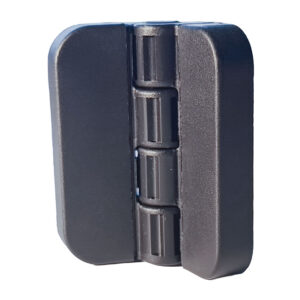
Friction and Snap Hinge
Friction and snap hinges are designed to keep doors, flaps, and lids in a stable position during use, without the need for additional locking mechanisms. Friction hinges apply constant and uniform resistance throughout the entire range of rotation—usually adjustable via a screw—so that the door can be stopped at any intermediate angle chosen by the operator. Snap-action hinges incorporate a snap spring that locks the movement in certain preset positions (typically two or three fixed angles).
Both types are used on equipment cabinets, electrical panels, control panels, and industrial enclosures where it is helpful for the door to remain open during maintenance or inspection.
FOCUS
The choice between a friction hinge and a snap hinge depends on the intended use. If you need to stop the door at any point along its travel, the friction hinge is the most flexible solution, because the holding torque is adjustable and acts continuously throughout the entire range of rotation.
If, on the other hand, the requirement is to have a few well-defined and repeatable opening angles (useful for standardized operations or to prevent excessive opening), the snap hinge with preset positions is preferable.
The expected number of opening/closing cycles must also be taken into account: in high-quality friction-type models, the holding torque remains stable even after thousands of cycles, while in snap-action models, the locking springs are generally made of stainless steel to ensure consistent holding power over time.
FAQ
What is the difference between a friction hinge and a snap hinge?
The friction hinge holds the door in any position thanks to constant, adjustable friction throughout its full range of motion. The snap-action hinge, on the other hand, locks the door only in certain preset positions via a snap spring, requiring a push to move from one position to another.
Is the torque of a friction clutch adjustable?
Yes, on most models, the spring tension can be adjusted by turning a screw or the central pin, allowing you to calibrate the resistance based on the weight of the door and its intended use.
In which applications is it best to use snap-action hinges with preset positions?
They are recommended when the door needs to stop automatically at standard, repeatable opening angles, such as on electrical cabinets or operator panels.
-

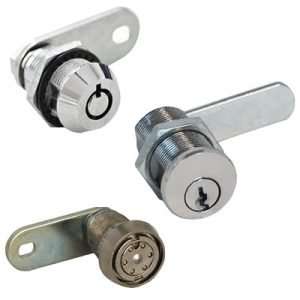
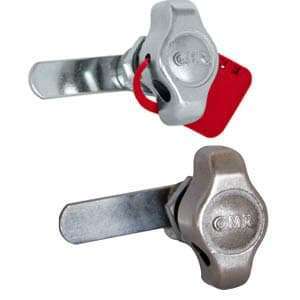
Cam locks (83)
-
Master key locks (71)
-
Waterproof/stainless locks (36)
-
1/4-turn budget locks (34)
-
Detachable barrel locks (27)
-
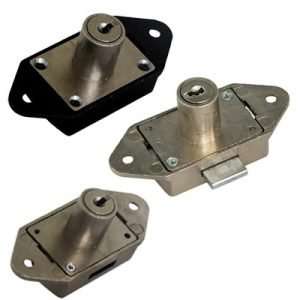
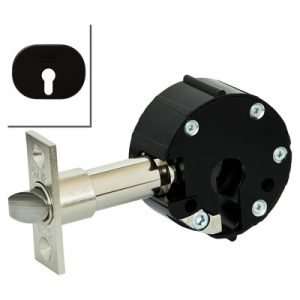
Deadbolt locks (21)
-
Locks for waste bins (20)
-
Handles and knobs (17)
-
Pivot locks (17)
-
Universal Wafer Cam locks (16)
-
Special custom-made locks (13)
-
Reprogrammable locks (13)
-
Locks with swivel handles (11)
-
Camlocks with notched cam (10)
-
Combination locks (10)
-
Multi-point locks (9)
-
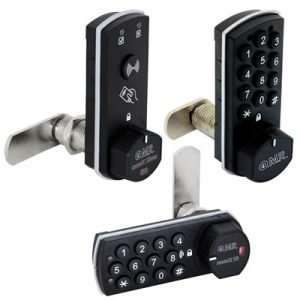
Electronic locks for cabinets, drawers, doors (7)
-
Locks with return spring (7)
-
Universal pin tumbler locks (7)
-
Microlocks (6)
-
Locks with rotating rods (6)
-
Push-button locks (5)
-
Cross key locks (5)
-
OTTO Series (4)
-
Ratchet lock (3)
-
Electric contact locks (2)
-
Padlockable locks (2)