Free-swinging hinges
Free-swing hinges are the most common type of industrial hinge: the movement occurs without any retaining, locking, or return mechanism, giving the door complete freedom of rotation throughout the full range provided by the model. They represent the simplest, most economical, and most reliable solution when it is not necessary for the door to remain stationary in a specific position or to close on its own: keeping the door closed is the responsibility of the lock or the associated locking system.
Available in a variety of materials—engineering plastics, aluminum, die-cast metal, iron, and zinc alloy—with rotation angles typically ranging from 180° to over 270°, they are suitable for a wide range of applications on technical cabinets, electrical panels, panels, and industrial furniture.
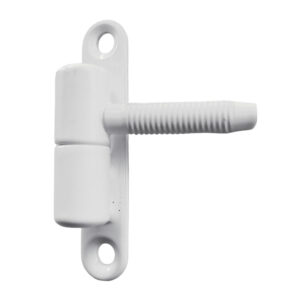
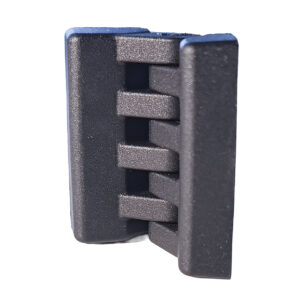
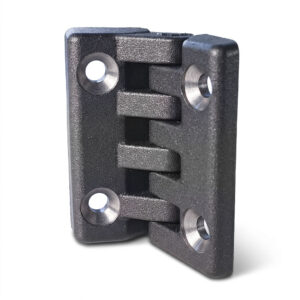
FOCUS
Free-swinging hinges are the right choice when the door is already held in place by other components, typically a lock or a dedicated locking device—this is the most common scenario for electrical panels, industrial cabinets, and technical doors.
When making your selection, first consider the material based on the intended environment: aluminum and zinc alloy offer good corrosion resistance and are also suitable for outdoor use or environments subject to washing, while iron and die-cast metal are preferable for heavier loads and dry environments. Next, check the specified maximum rotation angle (180°, 210°, or over 270°, depending on the model) in relation to the available opening space, as well as the number of mounting holes to ensure the door remains securely fastened over time.
FAQ
What does “free-swinging hinge” mean?
This refers to a hinge without any friction, latch, or return mechanisms: the door swings freely through its entire intended range of motion, without stopping at intermediate positions or automatically locking on its own.
If the hinge doesn’t hold the door in place, how does the door stay closed?
The door is secured by a lock or another dedicated locking device that is integrated with the hinge: this is the most common configuration for electrical panels and equipment cabinets.
Are free-swinging hinges also suitable for heavy loads?
It depends on the material and the number of mounting holes: models made of iron or die-cast metal generally offer a higher load capacity than those made of engineering plastic, while maintaining the same range of motion.
-

Cam locks (83)
-
Master key locks (71)
-
Waterproof/stainless locks (36)
-
1/4-turn budget locks (34)
-
Detachable barrel locks (27)
-
Deadbolt locks (21)
-
Locks for waste bins (20)
-
Handles and knobs (17)
-
Pivot locks (17)
-
Universal Wafer Cam locks (16)
-
Special custom-made locks (13)
-
Reprogrammable locks (13)
-
Locks with swivel handles (11)
-
Camlocks with notched cam (10)
-
Combination locks (10)
-
Multi-point locks (9)
-
Electronic locks for cabinets, drawers, doors (7)
-
Locks with return spring (7)
-
Universal pin tumbler locks (7)
-
Microlocks (6)
-
Locks with rotating rods (6)
-
Push-button locks (5)
-
Cross key locks (5)
-
OTTO Series (4)
-
Ratchet lock (3)
-
Electric contact locks (2)
-
Padlockable locks (2)